
How to Ship a Car You Bought Online
❓ Quick Answer:
Buying a car online and shipping it involves four steps: ensuring that the title is released by the seller, booking a licensed auto transport broker, coordinating the pickup of the car from the seller’s location, and having the car delivered right to your doorstep. On average, car shipping and car transport services take 3–7 days, and costs vary between $350–$1,900 depending on distance and transport type.
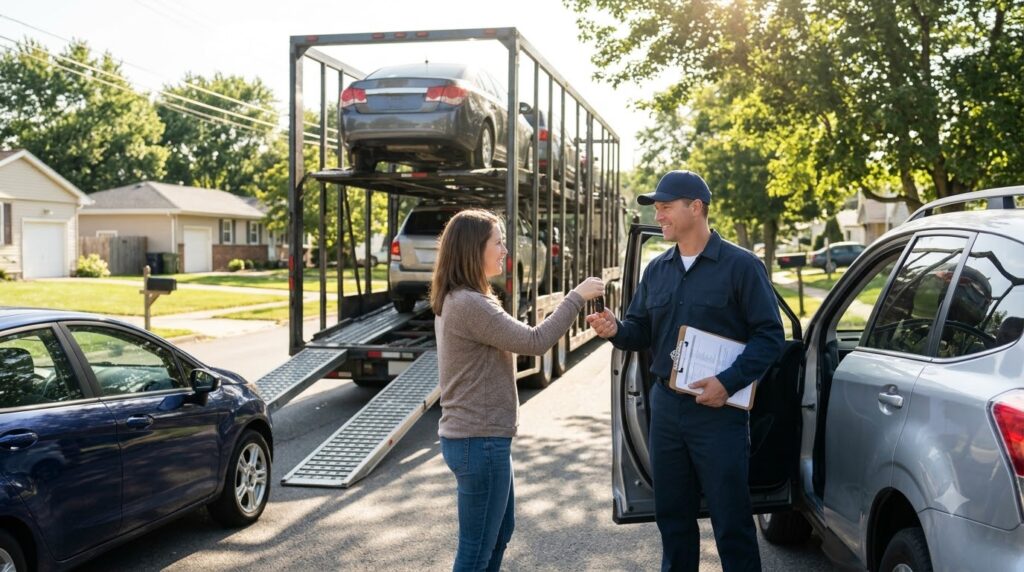
Table of Contents
Buying a car from a dealership in another state, winning a bid on an online auction, or purchasing from a private seller across the country is more common than ever. Car shipping for an online purchase works well — but only if you line up the car transport service before the payment clears.
Here’s the full picture, from the moment you hit “Buy Now” to the moment your car pulls into your driveway. If you need to ship a car to another state, this guide covers every step.
Step 1: Confirm the Title and Payment Terms Before You Book Transport
The single biggest mistake online car buyers make is booking a car transport service before sorting out the paperwork. If the title isn’t released or payment hasn’t cleared, some sellers won’t allow pickup — which means your carrier shows up and drives away empty, and you may still owe a dry-run fee.
Before you contact a broker:
- Confirm the seller will release the keys and title at the time of pickup. For dealers, this is standard. For private sellers and auction platforms, confirm in writing.
- Clarify who signs the Bill of Lading. The Bill of Lading is the official condition report the driver completes at pickup. Someone needs to be present — either the seller or a designated representative — to walk the car with the driver and sign the form.
- Check whether the vehicle is drivable. If it’s not — seized engine, flat tires, no battery — tell your broker upfront. Shipping an inoperable car is completely doable, but it requires winch-loading equipment and adds $150–$300 to the base rate. Discovering this at pickup causes delays and surprise charges.
Step 2: Get a Quote and Book Your Car Transport Service
Once the paperwork side is confirmed, getting a quote for car shipping takes under two minutes.
US Car-Go Freight is a licensed auto transport broker (DOT #3911910, MC #1444325) with access to 15,000+ FMCSA-registered carriers running routes across all 48 contiguous states. When you submit a quote request, you’re not getting a single carrier’s rate — you’re getting competitive pricing across the carrier network on your specific route and dates.
What your quote will depend on:
- Distance is the biggest factor. A 300-mile move from a neighboring state costs $350–$600. A cross-country move from California to the East Coast runs $1,100–$1,900.
- Open transport is how 93% of cars ship in the US. It’s safe, well-established, and significantly more affordable. Enclosed transport uses a fully covered trailer and costs 40–60% more — the right choice for luxury vehicles, classic cars, or any car valued over $70,000. For a used car you bought online, open transport is almost always the right call.
- Vehicle size. A standard sedan is the base price. Full-size trucks and SUVs typically add $100–$200. Electric vehicles add $100–$200 as well, partly due to battery weight.
- Pickup flexibility. Offering a 3–5 day pickup window rather than a fixed date typically saves 10–20% because carriers can route more efficiently.
Step 3: Schedule Pickup at the Seller’s Location
This is where car shipping for an online purchase differs from a standard move — the pickup address is wherever the seller is, not where you are.
When you book, give your broker the seller’s address as the pickup location. If the seller is at a dealership, pickup is at the dealership. If it’s a private seller’s home, confirm that the street is accessible to a large carrier truck (75–80 feet long). Tight residential streets, gated communities, or low-clearance areas may require an alternate nearby meeting point, like a large parking lot a few blocks away.
Who needs to be there at pickup: There should be someone from the seller’s end who can be present to hand over the key and sign the Bill of Lading. The driver would do the inspection of the vehicle and mention the details of any damages, if any. That Bill of Lading is your protection — if a scratch shows up at car delivery that wasn’t noted at pickup, that’s your basis for a claim.
Step 4: Prepare the Vehicle for Transport
The seller’s side: whoever releases the car needs to do a few things before the driver arrives.
- Wash the exterior so existing damage is visible and documented accurately on the Bill of Lading.
- Fuel tank at one-quarter — no more than half. A full tank adds 90–120 pounds, which creates complications under federal carrier weight limits.
- Remove personal items from the cabin and trunk. Personal belongings are not covered by the carrier’s cargo insurance.
- Disable any aftermarket alarms. Third-party alarms are sensitive to transport vibration and can trigger repeatedly in transit, draining the battery.
- Leave one set of keys with the driver — remove all spares from the vehicle.
If you bought an electric vehicle, most carriers prefer a 20–60% charge level before loading — not full. Confirm this with your US Car-Go Freight coordinator at booking. See our full guide on how to prepare your car for shipping.
Step 5: Track Your Shipment and Inspect at Delivery
Transit time depends on distance:
| Distance | Typical Transit Time |
|---|---|
| Under 500 miles | 1–3 days |
| 500–1,000 miles | 2–4 days |
| 1,000–1,500 miles | 3–6 days |
| 1,500–2,000 miles | 5–8 days |
| Cross-country (2,000+ miles) | 7–14 days |
Your US Car-Go Freight coordinator stays in contact throughout. The carrier will provide you with a delivery time slot, which is usually a 24-hour window for the day before delivery.
At delivery, this should be done before signing any documents: Inspect the vehicle thoroughly against the conditions listed in the Bill of Lading from pickup. If you see damage that wasn’t noted at pickup, document it on the delivery report before you sign. Never sign a clear delivery report if visible damage is present — that signature releases the carrier from liability for anything not noted at delivery.
All carriers in the US Car-Go Freight network carry FMCSA-required cargo insurance, typically $100,000–$250,000 in coverage.
What Does It Cost to Ship a Car You Bought Online?
| Scenario | Typical Cost (Open Transport) |
|---|---|
| Same-state, under 300 miles | $200–$450 |
| Neighboring state, 300–600 miles | $400–$700 |
| Mid-range, 600–1,200 miles | $700–$1,200 |
| Cross-country, 1,500–2,500 miles | $1,000–$1,900 |
Timing matters more than most buyers expect. June–August and October–December are the most expensive windows. January, February, and September consistently offer the best pricing — shipping off-peak can save $150–$400 on the same route. See our detailed car shipping cost guide for more detail.
Frequently Asked Questions
Yes. You don’t need to hold the title yourself for transport. The seller releases the vehicle to the carrier, and the title follows through standard transfer paperwork. What you need is confirmation that the seller will release the keys and sign the Bill of Lading at pickup.
You can book directly through US Car-Go Freight using the auction lot address as pickup. Arrange for lot staff to release the vehicle to the carrier. It works smoothly as long as the lot knows the carrier is coming and the vehicle is ready.
Yes. US Car-Go Freight ships inoperable vehicles across all 48 contiguous states using winch-loading equipment. This adds $150–$300 to the base rate. Always disclose inoperable status when requesting your quote — not at pickup.
2–3 weeks before you need pickup. In case there is a deadline set for vehicle pickup at the auction or sale, factor that into your booking date and tell your coordinator.
Yes, someone should be available to sign the Bill of Lading and to examine the vehicle. This is your one opportunity to document any new damage before the carrier leaves.
Door-to-door car transport means the carrier picks up at the seller’s address and delivers directly to your location — no terminals, no drop-offs midway. It’s the standard service US Car-Go Freight provides on every shipment across all 48 contiguous states.
Why Ship With US Car-Go Freight?
US Car-Go Freight is a licensed auto transport broker based in Tampa, FL — DOT #3911910, MC #1444325. Vehicle transport through our network means every shipment includes pickup at the seller’s address, transport on a licensed FMCSA-registered carrier, cargo insurance coverage, Bill of Lading documentation at both ends, and coordinator support from booking to delivery. No hidden fees added at pickup.
Need to ship a car to another state? We cover all 48 contiguous states with a network of 15,000+ FMCSA-registered carriers. Get instant competitive pricing across the full network on your route.
Or call us: (888) 249-8840
Recent Posts.
- How to Ship a Car You Bought Online
 How to Ship a Car You Bought Online ❓ Quick… Read more: How to Ship a Car You Bought Online
- US Car-Go Freight Logistics Reviews: What Customers Say
 US Car-Go Freight Logistics Reviews Shipping a car to… Read more: US Car-Go Freight Logistics Reviews: What Customers Say
- US Car-Go Freight Logistics: Door-to-Door Car Shipping Services
 US Car-Go Freight Logistics Moving a car from one state… Read more: US Car-Go Freight Logistics: Door-to-Door Car Shipping Services

