
Car Shipping Cost Calculator: 2026 Price Guide by Distance
❓ Quick Answer:
Car shipping costs in 2026 range from $200 up to $2,200, depending on the distance, type of vehicle, and mode of transportation. The rate for open transport is $0.60-$1.75 per mile and $40-$60 percent more for enclosed transport. For instance, 1,000 miles of open transport will cost about $900-$1,200. Please use our online instant quote calculator below to get your rate.
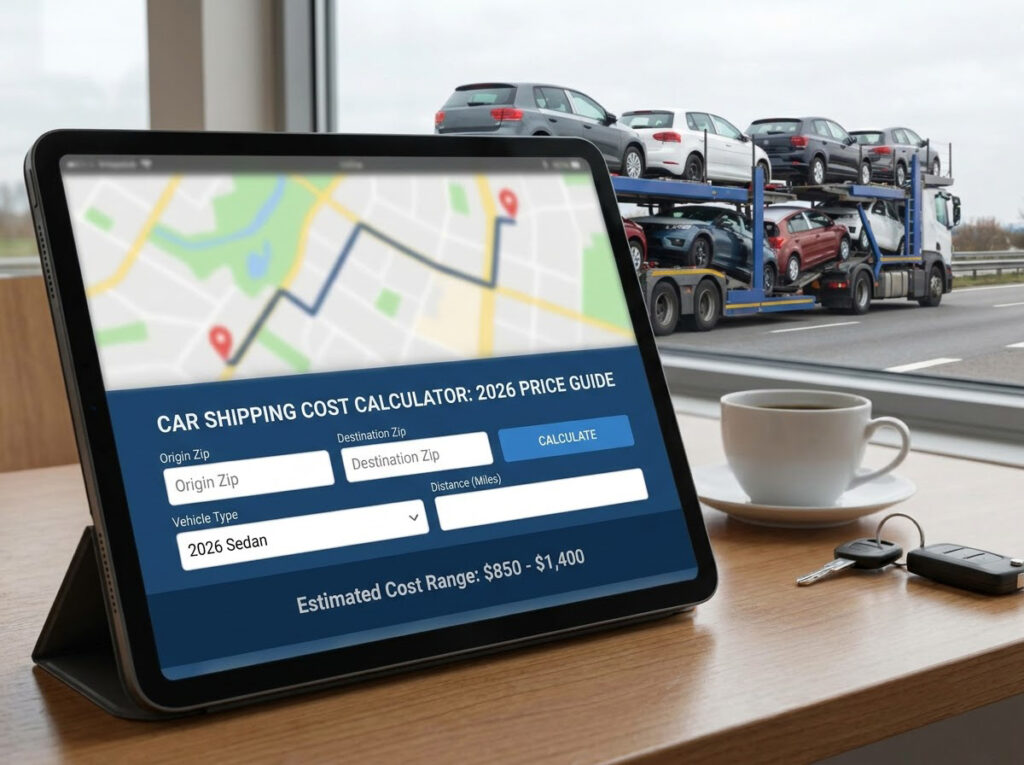
Table of Contents
How Car Shipping Prices Are Calculated
If you’ve ever searched for car shipping quotes and gotten wildly different numbers, you’re not imagining things. Auto transport pricing isn’t random it follows a logic that makes complete sense once you understand how the industry works.
Here’s the short version: carriers have fixed costs every time they put a truck on the road — fuel, driver pay, insurance, equipment wear. Those fixed costs don’t change much whether they’re driving 300 miles or 1,500 miles. What changes is how many miles those costs get spread across. That’s why the rate per mile decreases substantially when the distance increases. A 300-mile move would be costly per mile because the cost that needs to be incurred is packed in one short move. But a 1,500-mile move would be cheaper on a per-mile basis.
On top of distance, five other factors shape your final number:
- Distance is the biggest driver — more miles means a higher total price but a lower per-mile rate.
- Vehicle size matters because larger vehicles take more trailer space and add weight. A pickup truck costs more to ship than a compact sedan on the same route.
- Transport type — open or enclosed — creates a 40–60% price difference. Open is how 93% of cars ship. Enclosed is the right choice for luxury, classic, or high-value vehicles.
- Season moves rates up and down by 15–25% depending on demand. Summer and snowbird season (October through December) are the most expensive windows.
- Pickup flexibility is an underused lever. Offering a 3–5 day pickup window instead of a fixed date can reduce your quote by 10–20% because it lets carriers route more efficiently.
Understanding these five factors puts you in control of your cost — and helps you spot an unrealistically low quote before it turns into a problem.
Car Shipping Cost by Distance — 2026 Price Table
The table below reflects real 2026 market pricing based on current carrier rate data across the US Car-Go Freight network and verified industry benchmarks. All prices are for a standard operable sedan on open transport under typical demand conditions.
| Distance | Total Cost (Open) | Total Cost (Enclosed) | Transit Time |
|---|---|---|---|
| Under 250 miles | $200 – $450 | $400 – $700 | 1 – 2 days |
| 250 – 500 miles | $350 – $600 | $600 – $950 | 1 – 3 days |
| 500 – 750 miles | $500 – $750 | $800 – $1,150 | 2 – 4 days |
| 750 – 1,000 miles | $700 – $950 | $1,000 – $1,400 | 3 – 5 days |
| 1,000 – 1,500 miles | $850 – $1,200 | $1,200 – $1,700 | 3 – 6 days |
| 1,500 – 2,000 miles | $1,000 – $1,400 | $1,500 – $2,000 | 5 – 8 days |
| 2,000+ miles (cross-country) | $1,100 – $1,900 | $1,600 – $2,500 | 7 – 14 days |
Real market context: As of August 2026, industry-wide averages for a standard sedan on a typical 1,000-mile open-transport route run approximately $1,150–$1,250 per shipment. Enclosed transport on the same route typically averages $1,750–$1,850 — a premium of roughly $600 over open rates.
What moves prices within these ranges:
- Major metro pickup/delivery = lower end of range (high carrier frequency)
- Rural or remote locations = higher end of range (detour surcharge possible)
- Peak season (June–August, October–December) = prices push toward the upper end
- Off-peak months (January–February, September) = prices sit at the lower end
- Flexible pickup window = helps keep you at the lower end regardless of season
Cost Per Mile Breakdown
Understanding the per-mile rate helps you quickly sense-check any quote you receive. If a quote looks too low, compare it to the per-mile benchmarks below.
| Distance Range | Open Transport ($/mile) | Enclosed Transport ($/mile) |
|---|---|---|
| Under 500 miles | $1.20 – $1.75 | $1.80 – $2.45 |
| 500 – 1,000 miles | $0.85 – $1.20 | $1.30 – $1.80 |
| 1,000 – 1,500 miles | $0.70 – $0.95 | $1.10 – $1.50 |
| 1,500 – 2,000 miles | $0.60 – $0.80 | $0.95 – $1.30 |
| 2,000+ miles | $0.55 – $0.90 | $0.85 – $1.30 |
The math behind this is straightforward. At 300 miles, a carrier’s fixed costs per load (roughly $200–$300) represent over half the total job value — so the per-mile rate has to stay high. At 2,000 miles, those same fixed costs represent a small fraction of the total — so carriers can offer a much more competitive per-mile rate and still make the trip worthwhile.
Red flag to know: If you receive a quote that’s significantly below the low end of these per-mile ranges, that’s a warning sign. Quotes that seem impossibly cheap at the start are often revised upward at pickup, which is the root of most bait-and-switch complaints in the auto transport industry. A legitimate broker like US Car-Go Freight will give you a realistic quote based on live carrier rates, not an artificially low number designed to win your deposit.
Open vs Enclosed Transport: The Price Difference
This is the single biggest pricing decision you’ll make when booking car shipping.
Open transport is how 93% of vehicles in the US get shipped. It’s the same open carrier trailers you see on the highway loaded with new cars from factories to dealerships. Safe, reliable, and significantly more affordable — open transport is the right choice for the vast majority of everyday vehicles.
Enclosed transport uses a fully covered trailer with no exposure to weather, road debris, or UV rays. It costs more because enclosed trailers carry fewer vehicles (typically 2–6 versus 10 on an open carrier), so the cost per vehicle is higher. Worth every dollar for the right vehicle — unnecessary expense for most others.
| Factor | Open Transport | Enclosed Transport |
|---|---|---|
| Average 2026 cost | $1,205 | $1,804 |
| Premium over open | — | +$599 (approx 50%) |
| Vehicles per trailer | Up to 10 | 2 – 6 |
| Weather protection | Exposed | Fully protected |
| Best for | Standard vehicles | Luxury, classic, EV, exotic |
| Availability | High — most routes daily | Lower — book 2 weeks ahead |
| % of all US shipments | 93% | 7% |
Choose open transport if you drive a standard sedan, SUV, pickup truck, crossover, or minivan with no special modifications. The vehicle arrives in the same condition it was loaded – millions of cars ship open every year without issue.
Choose enclosed transport if your automobile’s value exceeds $70,000, it is a classic or collector car, an exotic model (for example Ferrari, Lamborghini, Porsche 911, and Bentley), a custom-built vehicle or one that has been customized, or an expensive electric car where both its battery pack and exterior are important.
Price by Vehicle Type
Vehicle size directly affects your shipping cost because it determines how much trailer space your car occupies and how much weight it adds to the load.
| Vehicle Type | vs. Standard Sedan | Example Models |
|---|---|---|
| Motorcycle | −20% to −30% | Harley-Davidson, Honda, BMW |
| Compact/small sedan | Base price | Toyota Corolla, Honda Civic, Hyundai Elantra |
| Standard sedan | Base price | Toyota Camry, Honda Accord, Nissan Altima |
| Small SUV/zCrossover | +$50 – $100 | Honda CR-V, Toyota RAV4, Ford Escape |
| Full-size SUV | +$100 – $175 | Ford Explorer, Chevy Tahoe, GMC Yukon |
| Full-size pickup truck | +$100 – $200 | Ford F-150, Ram 1500, Chevy Silverado |
| Oversized truck/van | +$175 – $300 | Ford F-350, Sprinter Van, Ram ProMaster |
| Inoperable vehicle | +$150 – $300 | Any non-running vehicle requiring winch loading |
| Electric vehicle | +$100 – $200 | Tesla Model 3/S/Y/X, Rivian, Lucid Air |
A note on electric vehicles: EVs cost slightly more to ship for two reasons. First, the battery packs add significant weight compared to equivalent gas-powered vehicles. Second, carriers have specific pre-transport requirements for lithium batteries — typically a charge level of 20–40%, not a full charge — which require additional coordination. Enclosed transport is strongly recommended for premium EVs.
A note on inoperable vehicles: A car that can’t be driven onto the carrier requires winch-loading equipment and takes significantly longer to load. This adds $150–$300 to the base rate regardless of distance. Always disclose inoperable status when booking — failing to do so can result in an on-site price revision at pickup.
Seasonal Pricing Calendar
Timing your shipment can save you $150–$400 depending on how flexible you are. Here’s how demand and therefore pricing, moves through the year.
| Month | Demand Level | Price vs Average | Notes |
|---|---|---|---|
| January | Low | −10% to −15% | Post-holiday lull, fewest shippers |
| February | Low | −10% to −15% | Slowest month of the year |
| March | Rising | −5% to base | Spring move season beginning |
| April | Medium | Base price | Balanced supply and demand |
| May | Rising | +5% to +10% | College move season starts |
| June | Peak | +15% to +25% | Highest demand of the year |
| July | Peak | +15% to +20% | Summer peak continues |
| August | High | +10% to +15% | Back-to-school moves add volume |
| September | Dropping | Base to −5% | One of the best windows to ship |
| October | Rising | +10% to +15% | Snowbird season begins — FL routes spike |
| November | High | +15% to +20% | Peak snowbird demand, NY/IL/OH to FL |
| December | Medium-High | +5% to +10% | Holiday period — some routes ease |
Best months to ship: January, February, and September consistently offer the most competitive pricing and fastest pickup windows. With just two or three weeks’ flexibility in scheduling, changing a shipment from June to September on the same route will save you between $200 and $400.
Routes that carry “snowbirds” (NY, IL, OH, MI to FL): There are huge price hikes in these routes from October through December, as many people retire and move south. Book 4–6 weeks in advance if shipping during this window. The same routes in September just before the rush, are 20–30% cheaper than in November.
City-Pair Price Examples
Prices for the most frequent routes in 2026, using open carriage of a standard automobile in normal market circumstances.
| Route | Distance | Open Transport | Enclosed Transport | Transit |
|---|---|---|---|---|
| New York, NY → Miami, FL | ~1,280 mi | $950 – $1,200 | $1,400 – $1,800 | 4 – 6 days |
| New York, NY → Orlando, FL | ~1,090 mi | $900 – $1,150 | $1,300 – $1,700 | 3 – 5 days |
| New York, NY → Los Angeles, CA | ~2,800 mi | $1,200 – $1,600 | $1,800 – $2,400 | 7 – 10 days |
| Los Angeles, CA → Houston, TX | ~1,550 mi | $900 – $1,200 | $1,300 – $1,800 | 4 – 6 days |
| Los Angeles, CA → Dallas, TX | ~1,430 mi | $850 – $1,150 | $1,250 – $1,700 | 4 – 5 days |
| Chicago, IL → Miami, FL | ~1,380 mi | $900 – $1,150 | $1,300 – $1,700 | 4 – 6 days |
| Chicago, IL → Los Angeles, CA | ~2,020 mi | $1,050 – $1,350 | $1,550 – $2,050 | 5 – 8 days |
| Miami, FL → New York, NY | ~1,280 mi | $950 – $1,200 | $1,400 – $1,800 | 4 – 6 days |
| San Francisco, CA → Dallas, TX | ~1,770 mi | $1,000 – $1,350 | $1,500 – $2,000 | 4 – 7 days |
| Houston, TX → Atlanta, GA | ~790 mi | $700 – $950 | $1,000 – $1,400 | 2 – 4 days |
| Seattle, WA → Phoenix, AZ | ~1,420 mi | $850 – $1,100 | $1,250 – $1,650 | 3 – 6 days |
| Boston, MA → Chicago, IL | ~980 mi | $800 – $1,050 | $1,150 – $1,600 | 3 – 5 days |
Prices reflect current August 2026 market conditions. SUVs and trucks typically add $100–$200. Enclosed adds approximately 40–50% to base open rates. Get your real-time quote at uscargofreight.com/get-a-quote.
5 Ways to Lower Your Car Shipping Cost
None of these require compromising on service quality. They’re practical booking strategies that experienced shippers use every time.
- Book 2–3 weeks in advance
Last-minute bookings — especially during peak season — cost more because carrier options are limited. Bookings between 2 to 3 weeks before the trip allow the dispatcher adequate time to obtain competitive pricing for your route. For peak months such as June and July, 4 weeks is better. - Offer a flexible pickup window
This is the single most effective pricing lever most people never use. Instead of requesting pickup on a specific date, offer a 3–5 day window. Carriers can route more efficiently with flexible loads, and those savings get passed to you. A flexible window typically saves 10–20% compared to a fixed-date request. - Choose open transport for standard vehicles
Unless your car genuinely needs the protection of an enclosed carrier, open transport delivers it safely at 40–60% less cost. The vast majority of vehicles ship open without any issue. - Ship during off-peak months
January, February, and September are consistently the cheapest months to ship. If you can shift your timeline by a few weeks away from June–August or the October–December snowbird rush, you’ll see meaningful savings. - Use a metro-area pickup point
If you live in a rural area or a dense downtown where large carrier trucks have access trouble, meeting the carrier at a nearby open location — a shopping center parking lot, a gas station — can reduce any detour surcharge and speed up carrier assignment. Ask your US Car-Go Freight coordinator about this when booking.
What Your Quote Actually Includes
A legitimate auto transport quote from US Car-Go Freight covers the following no hidden fees added at pickup.
Included in every shipment:
- Pickup at your specified address (or nearest accessible point)
- Transport on a licensed, FMCSA-registered carrier
- Cargo insurance coverage ($100,000–$250,000 depending on carrier)
- Vehicle inspection and Bill of Lading documentation at pickup and delivery
- Delivery to your specified destination address (or nearest accessible point)
- Coordinator support throughout the shipment
Not included in base quote (disclosed upfront):
- Enclosed transport upgrade (if requested)
- Expedited shipping (if requested)
- Inoperable vehicle surcharge (if applicable)
- Remote location surcharge (if applicable – disclosed before booking)
Every charge that applies to your shipment is disclosed before you pay a deposit. No surprise additions at pickup. That’s the commitment we make to every customer — and it’s the transparency that most pricing complaints in this industry come down to when it’s missing.
After Arrival: Registering Your Car in Texas
If you are relocating to Texas – not just temporarily shipping the vehicle – here is what you need to do with your car after it arrives:
- Vehicle Registration:
Within 30 days after moving to Texas, new residents are required to register their cars. The Application for Texas Title form (Form 130-U), evidence of Texas auto insurance, and your title from another state are the necessary paperwork. - Texas Vehicle Inspection:
Before you may register, your vehicle must pass a Texas state safety inspection. Unlike California, the majority of Texas counties do not require emissions testing; however several counties in the Dallas-Fort Worth & Houston regions do. Find an authorized inspection station close to your new address. - Driver’s License:
After moving to Texas, new residents have 90 days to get a driver’s license. Bring proof of residency in Texas (such as a utility bill or lease agreement), your Social Security number, and your current driver’s license to the closest Texas DPS office. - Auto Coverage:
Texas mandates 30/60/25 minimum liability coverage, which is $30,000 for each person’s physical injury, $60,000 for each accident & $25,000 for property damage. Update your insurance policy to reflect your new Texas address before or immediately after arrival.
Frequently Asked Questions
Car shipping costs in 2026 vary between about $200 for a very short local move and $2,200 or higher for a lengthy cross-country move with an enclosed carrier. The open transport industry average for 2026 is approximately $1,205 for a median 1,000-mile journey. The specific price will depend on the specific route, vehicle size, transport type, and the season.
Open transport is the most affordable option since it represents 93% of all US auto moves and costs 40-60% less than enclosed transport. Other than using the open service, the most cost-effective method that won't sacrifice service quality is having a pickup window of 3-5 days and booking your move during the off-season (January, February, or September).
Per-mile rates range from $0.55 to $1.75 for open transport, depending on distance. Short hauls under 500 miles cost the most per mile, around $1.20 to $1.75 because carrier fixed costs are spread over fewer miles. Long hauls over 1,500 miles drop to $0.55–$0.80 per mile because those same fixed costs are spread across a much longer trip. This is why cross-country shipping is more cost-efficient per mile than regional moves.
Yes significantly. Full-size pickup trucks and large SUVs typically cost $100–$200 more than a standard sedan on the same route because they take up more trailer space and add weight. Motorcycles cost 20–30% less than a sedan. Inoperable vehicles add $150–$300 for winch-loading equipment.
Summer is peak moving season. College students relocating, families moving between school years, and high overall demand push carrier rates up 15–25% from June through August. More shippers chasing the same carrier capacity means prices rise. January, February, and September are consistently the cheapest windows for the same routes.
Book 2–3 weeks in advance, offer a flexible 3–5 day pickup window, choose open transport for a standard vehicle, and ship during off-peak months if your timing allows. Getting your quote from a licensed broker with access to a large carrier network like US Car-Go Freight (DOT #3911910, MC #1444325) also ensures you're seeing competitive real-time pricing rather than a single carrier's fixed rate.
For most standard vehicles, no open transport is safe, affordable, and how the vast majority of cars move. Enclosed transport is genuinely worth the premium for vehicles valued over $70,000, classic and collector cars, exotic brands, heavily modified vehicles, and high-end EVs where protection from road debris and weather is critical. The cost difference runs about $400–$600 more than open on most routes.
Transit time ranges from 1–2 days for short regional moves under 250 miles to 7–14 days for cross-country shipments over 2,000 miles. Most shipments fall in the 3–6 day range. Note that total time from booking to delivery includes a 1–3 day pickup window before transit begins, so plan for 7–10 days total from booking to delivery for most routes.
Yes. US Car-Go Freight ships inoperable and non-running vehicles. The carrier uses winch-loading equipment to load the vehicle safely without driving it onto the trailer. This adds $150–$300 to the base shipping rate. Always disclose the inoperable status when booking failing to do so can result in a price revision at pickup when the driver arrives with standard equipment.
All carriers in the US Car-Go Freight network carry mandatory cargo insurance as required by the FMCSA typically $100,000 to $250,000 in coverage. If damage occurs during transport, document it on the delivery Bill of Lading before signing, photograph it immediately, and contact your US Car-Go Freight coordinator right away. Never sign a clear delivery confirmation if damage is visible.
Ready to Get Your Exact Price?
The tables and estimates above give you a solid planning baseline — but your real price depends on your specific route, dates, and vehicle. Getting an exact quote from US Car-Go Freight takes under 60 seconds.
We’re a licensed and bonded auto transport broker (DOT #3911910 · MC #1444325) with access to 15,000+ vetted, FMCSA-registered carriers running routes across all 50 states. No hidden fees. No bait-and-switch pricing. Your quote reflects real carrier availability on your route and dates.
Or call us directly: (888) 249-8840 — available Monday to Saturday, with extended-hours support.
Last updated: September 2026. All pricing reflects verified August 2026 market data from the US Car-Go Freight carrier network and published industry benchmarks. Rates are subject to change based on fuel costs, seasonal demand, and carrier availability on specific routes.
Recent Posts.
- Ship Car Texas to Florida: Cost & Timeline (2026)
 Ship Car Texas to Florida: Cost & Timeline (2026) Table… Read more: Ship Car Texas to Florida: Cost & Timeline (2026)
 - Broker vs Carrier vs Marketplace Auto Transport: Complete Guide
 Broker vs Carrier vs Marketplace Auto Transport: Complete Guide ❓… Read more: Broker vs Carrier vs Marketplace Auto Transport: Complete Guide
 - Car Shipping Cost Calculator: 2026 Price Guide by Distance
 Car Shipping Cost Calculator: 2026 Price Guide by Distance ❓… Read more: Car Shipping Cost Calculator: 2026 Price Guide by Distance


