Shipping Car from New York to Florida: Cost, Time & What to Expect (2026)
❓ Quick Answer:
Shipping a car from New York to Florida costs between $750 to $1,300 for open transport & $1,200 to $2,000 for enclosed transport in 2026. Transit time is typically 3 to 7 days depending on your exact route, season, and carrier availability. Door-to-door auto transport service is available from any New York address to any Florida destination..
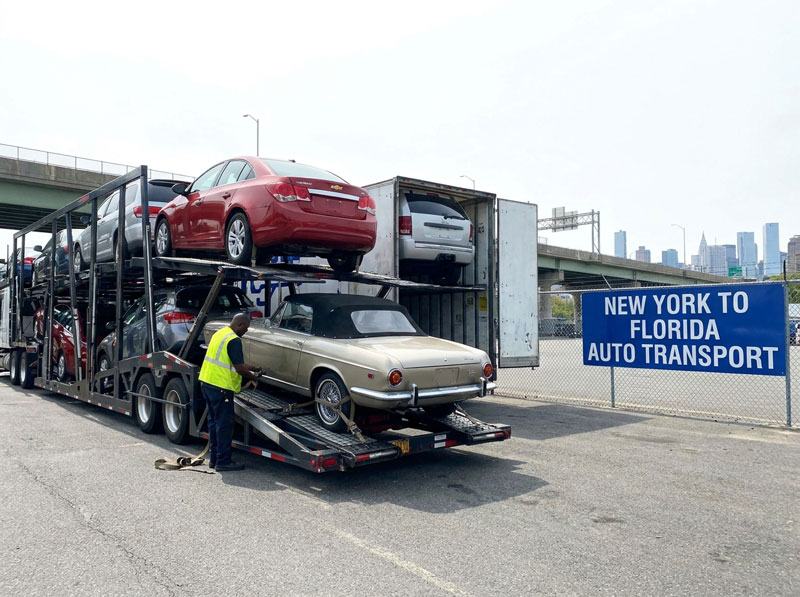
Table of Contents
How Much Does It Cost to Shipping Car From New York to Florida?
The New York to Florida route covers approximately 1,100 to 1,300 miles, depending on your exact pickup and delivery locations, making it one of the most traveled auto transport corridors in the United States.
Below Are the Latest 2026 Pricing Ranges Based on Current Market Trends:
| Transport Type | Sedan / Small Car | SUV / Truck | Luxury / Classic |
|---|---|---|---|
| Open Transport | $750 – $1,050 | $900 – $1,200 | $950 – $1,300 |
| Enclosed Transport | $1,200 – $1,600 | $1,400 – $1,900 | $1,600 – $2,300 |
| Expedited (Open) | $1,100 – $1,500 | $1,300 – $1,700 | N/A |
Popular Route Estimates (Open Transport, 2026):
| Route | Estimated Cost | Transit Time |
|---|---|---|
| New York City → Miami, FL | $950 – $1,200 | 4 – 6 days |
| New York City → Orlando, FL | $900 – $1,150 | 3 – 5 days |
| New York City → Tampa, FL | $880 – $1,100 | 3 – 5 days |
| Albany, NY → Jacksonville, FL | $800 – $1,000 | 3 – 5 days |
| Buffalo, NY → Fort Lauderdale, FL | $900 – $1,200 | 4 – 6 days |
| New York City → Fort Myers, FL | $980 – $1,250 | 4 – 7 days |
Important pricing note: Auto transport prices fluctuate daily based on carrier availability, fuel costs, and seasonal demand. The figures above reflect current 2026 market conditions & serve as planning estimates. Your actual quote from US Car-Go Freight will reflect real-time carrier pricing on your specific route.
How Long Does NY to FL Car Shipping Take?
Standard transit time for shipment from New York to Florida would be between 3 – 7 days from the moment the vehicle is picked up. The following factors influence the timeline:
- Distance and route: It takes anywhere from 1,100 – 1,300 miles to ship your car using the I-95, which is one of the busiest and most carrier-friendly corridors in the country. Carriers on this route run regularly which helps keep transit times predictable.
- Pickup window: Most auto transport shipments have a pickup period within 1–3 days after the chosen date. The clock on transit time begins only once the car is picked up and loaded on the carrier.
- Delivery location: Any delay related to deliveries into central Manhattan or downtown Miami is caused by large carrier truck restrictions in city streets. Using nearby suburban locations as pickup/delivery places might make the delivery faster.
- Expedited shipping services: In case you require the vehicle sooner than average, expedited shipping prioritizes your vehicle on the very next available carrier. This typically costs $200–$400 more but can shorten the overall process significantly.
- Weather and traffic: The I-95 corridor through New York and New Jersey is frequently subject to delays. Winter storms and holiday traffic between Thanksgiving & New Year are the most common causes of transit delays on this route.
Open vs Enclosed Transport: Which Is Right for You?
The two most popular means of transporting vehicles on the NY to FL journey are open and enclosed transport. Below is a comparison table to assist you in making your decision:
| Open Transport | Enclosed Transport | |
|---|---|---|
| Cost | Lower ($750–$1,300) | Higher ($1,200–$2,300) |
| Protection | Exposed to weather & debris | Fully protected |
| Availability | High (daily routes) | Limited (book ahead) |
| Best for | Standard vehicles | Luxury / classic cars |
| Usage | 90%+ customers | Premium option |
- Open transport should be chosen if: Your vehicle is a regular car, SUV, pick-up truck or minivan. Millions of automobiles have been transported through open auto transport in safety & it is an affordable way of transportation for most customers.
- Enclosed transport should be chosen if: You have a luxury car, such as a BMW, Mercedes, Porsche, or Tesla, a vintage car, or a collectible car that is valued over $75,000. Enclosed auto transport protects your vehicle against road debris, weather & UV exposure during transit.
What Factors Affect the Price?
Several key factors influence the cost of your New York (NY )to Florida (FL) vehicle transport service. Knowing them will help you plan your shipment & budget appropriately.
- Time of year (Snowbird Season)
This is one of the busiest snowbird routes in the country. Between mid-October and April, demand from retirees heading south surges, pushing prices up by 15–30%. Flexibility in dates would mean shipping your car in September or May, and saving about $150 – $300 on average. - Vehicle size and weight
Larger vehicles need more room on the trailer & more weight means additional expenses. Shipping a full-size pickup truck or SUV could cost you $100 – $200 extra compared to a smaller sedan on the same route. - Exact pickup and delivery locations
Shipping to and from major metro areas such as NYC, Miami, Orlando, and Tampa is normally cheaper as there is constant demand and carriers work regular routes through this area. Rural or remote addresses may require a detour, adding cost. - Pickup flexibility
Picking up between three and five days instead of on a specific date provides more scheduling options for carriers and usually leads to lower pricing. Exact-date pickups carry additional charges. - Fuel prices
Carrier fuel costs directly affect shipping rates. Diesel price fluctuations, particularly along the I-95 corridor, can move your quote by $50–$150 compared to different periods in the year. - Inoperable vehicles
If your vehicle won’t start or can’t be driven onto the carrier, loading equipment (winch or forklift) will be necessary. There’s an extra fee of about $150-$250 on top of the basic rate.
Snowbird Season: What NY-FL Shippers Need to Know
Snowbird season timeline:
| Period | Demand | Pricing | Recommendation |
|---|---|---|---|
| September | Low | Lowest | Best time to ship south |
| Oct–Nov | Rising | 15–25% above base | Book 3–4 weeks ahead |
| Dec–Jan | Peak | Highest | Book 4–6 weeks ahead |
| Feb–Mar | High | Elevated | Plan 2–3 weeks in advance |
| Apr–May | Dropping | Normalizing | Good return window |
| Jun–Aug | Moderate | Competitive | Flexible |
Practical snowbird tips:
- Book at least 3–4 weeks in advance during October through March
- If shipping from NYC or Long Island, consider meeting the carrier in a suburban area – large carrier trucks struggle in Manhattan and densely parked residential streets
- Midweek pickups (Tuesday through Thursday) tend to have faster carrier assignment than weekends
- If you return to New York every spring, ask about round-trip or seasonal discount pricing
Popular New York to Florida Routes
The NY to FL route involves all sorts of pickup and delivery services. Here are some examples of the most common routes & information about them:
- New York City to Miami
Longest and most common route – spanning 1,280 miles. Open transport cost: $950-$1,200. Transit: 4-6 days. Scheduling is relatively easy due to high year-round carrier frequency, although there may be scheduling difficulties in snowbird season, from October to February. - New York City to Orlando
Common route among families and snowbirds traveling to Central Florida. Distance: approx. 1,090 miles. Open transport cost: $900-$1,150. Transit: 3-5 days. The Orlando corridor experiences high year-round carrier traffic. - New York City to Tampa
Distance: approx. 1,080 miles. One of the busiest corridors in the East Coast; therefore, making pricing competitive, including the snowbird season. Open transport cost: $880-$1,100. Transit: 3-5 days. - Albany to Jacksonville
Shorter and more affordable route for upstate New York residents. Distance: approx. 960 miles. Open transport cost: $800-$1,000. Transit: 3-5 days. - Buffalo to Fort Lauderdale
Common route among snowbirds from western NY, traveling to South Florida. Distance: approx. 1,350 miles. Open transport cost: relatively $900-$1,200. Transit: 4-6 days.
How to Prepare Your Car for Shipping
Preparation in advance is crucial to avoid any damage to your vehicle & ensure its smooth transportation without any problems. Follow the guidelines below in advance before your carrier arrives:
Before pickup date:
- Wash your vehicle. Having a clean car will make it easy to check for any existing scratches & dents in your car at the time of inspection.
- Capture pictures of every side of your car. Take photos of all the sides, the roof, the bottom of your vehicle, and even inside your vehicle. These pictures can help you if there is any dispute.
- Remove any personal belongings. Carriers are not licensed to transport personal items & anything left in the vehicle is not covered by cargo insurance. Remove phone chargers, GPS devices, sunglasses & any valuables.
- Fill only one-fourth of your fuel tank. It is not necessary to have a full fuel tank because it will add extra weight. One quarter provides enough fuel for loading, unloading, and any short movements without excess weight.
- Turn off your car alarm since vibrations from the carrier vehicle could repeatedly set off your car’s alarm, causing battery loss on transit.
- Inflate your tires and test out the battery in your car, since there would be additional costs if there is any delay due to flat tires & dead batteries.
- You should also ensure that your car does not have any external add-ons such as antennas, spoilers, bike carriers, or other devices. If you are driving custom-built or lowered cars, then it must be noted during reservation time.
- List all damages on your car. Make sure that you prepare an inventory of all scratches and dents in your car, which need to be stated in your Bill of Lading.
What to Expect on Pickup and Delivery Day
- On pickup day:
Your carrier driver will contact you 12–24 hours before arrival to confirm the pickup window. Once the driver gets there, both of you will inspect the car together. The driver takes down the condition of the car as at that moment, using a document known as the Bill of Lading. Review this document carefully and make sure all existing damage is noted accurately before signing. Keep a copy of the signed Bill of Lading – you will need it if any damage occurs during transport.If your pickup address has restricted access for large trucks (narrow streets, low bridges, gated communities), arrange to meet the driver at a nearby open area such as a shopping center parking lot. This is common in New York City & is not an inconvenience – it simply ensures safe loading.
- During transport:
The car will be carried on a multi-vehicle carrier along the I-95 Corridor all the way to Florida。 Your US Car-Go Freight coordinator can provide you with status updates throughout the journey. Transit typically takes 3–7 days from pickup.
- On delivery day:
The driver will contact you approximately 12–24 hours before delivery. After the delivery of the car, inspect the car very thoroughly before signing the delivery bill of lading document. The inspection should cover the condition of every panel, the roof, the bottom of the car & the wheels. This can be compared with the photographs you had taken when picking up the car. If any new damage is present, note it on the Bill of Lading before signing and contact your shipping coordinator immediately. Do not sign a clear delivery form if damage is present.
How to Get the Best Price on NY to FL Car Shipping
Shipping a car from New York to Florida does not need to break your budget. Here are the most effective ways to reduce your cost:
- Book 3–4 weeks in advance during peak season
Bookings made on short notice during snowbird season (October to March) may lead to high prices due to decreased availability. Booking in advance means that you’ll have the chance to obtain competitive prices and the pick-up time of your choice. - Choose open transport
For most standard vehicles, open transport is perfectly safe and costs 30–40% less than enclosed. Unless you own a luxury or classic vehicle, open is the right choice. - Offer a flexible pickup window
A 3 to 5 day pick-up period will allow more leeway for carriers and lead to cheaper quotes than a firm pick-up date. Let the carrier know that you do not have a deadline if this is possible. - Ship during off-peak months
September is consistently the cheapest month for southbound NY to FL shipping. May and June are the cheapest for the northbound. Shifting your shipment by even two weeks around the snowbird season boundaries can save $150–$300. - Choose suburban pickup and delivery points
If you are in New York City or a dense urban area, meeting the carrier at a nearby suburban location reduces surcharges for urban access and can speed up carrier assignment. - Get an instant quote from US Car-Go Freight
US Car-Go Freight works with a network of 15,000+ vetted, FMCSA-registered carriers across the United States, including dedicated capacity on the NY-FL corridor year-round. Our licensed brokerage (DOT #3911910, MC #1444325) connects you with the most competitive real-time pricing available on your specific route.
Frequently Asked Questions
If you’re driving your car down, it’s going to cost somewhere between $750 - $1,300 for standard open transport. Want to keep your car sheltered? Enclosed transport runs higher, usually $1,200 to $2,000. Prices depend on a few things - your exact starting and ending locations, the time of year, the size of your ride, and how many carriers are ready when you need them.
Once your car’s loaded up - it usually takes about 3 to 7 days to reach Florida. That I-95 route gets a lot of auto transport traffic, so the timing’s pretty solid. Need it faster? You can ask for expedited shipping & shave off some days.
If you’re looking for a deal, September is your best bet. That’s right before “snowbird season” -October through March when everybody’s heading south and prices jump. To save, skip those crowded months and give your carrier some wiggle room on pickup dates.
Yes, it’s safe. Most carriers on the NY-to-FL route are professional and careful. Drivers with US Car-Go Freight are licensed, insured, and vetted by the FMCSA. Your car stays covered by cargo insurance the whole way.
Normally, you can stash up to 100 pounds of personal items in your car’s trunk or cargo space, but keep in mind these aren’t covered by cargo insurance. They don’t move household goods, so take out anything valuable or loose before shipping.
Someone needs to be present, either you or someone you trust. You’ll do an inspection & sign the Bill of Lading when your car gets picked up and again when it’s delivered. If you can’t make it, send a family member, friend, or property manager - just let your freight coordinator know ahead of time.
The Bill of Lading (BOL) is your record & evidence of the condition of your vehicle. Inspect the vehicle carefully upon pickup and delivery of the vehicle; note down any marks on it, and keep your copy. It will help you in case you want to file a damage claim.
Yes, you can. US Car-Go Freight transports all types of cars, including sedans, SUVs, pickups, minivans, motorcycles, and even non-operational cars. A larger car costs an extra $100-$200 as a large vehicle consumes more space and weight.
If you spot damage when your car arrives - write it down on the Bill of Lading before you sign. Snap some photos & contact your freight coordinator within 24 hours. All carriers carry cargo insurance, so don’t sign a clean delivery confirmation if there’s a problem.
It’s fast just hop onto the US Car-Go Freight website for an instant quote, or call (888) 249-8840. Their brokers are licensed and ready to answer your questions and give updated prices Monday through Saturday, with hours that fit your schedule.
Ready to Ship Your Car from New York to Florida?
US Car-Go Freight is a licensed and bonded auto transport broker (DOT #3911910 · MC #1444325) with access to 15,000+ vetted carriers nationwide. We handle New York to Florida shipments year-round, including during peak snowbird season, with door-to-door service from any New York address to any Florida destination.
Or just give us a call at (888) 249-8840. We are available Monday through Saturday, with extended hours support.
Last updated: April 2026. Pricing reflects current market conditions and is subject to change based on fuel costs, carrier availability, and seasonal demand.
Recent Posts.
- How Much Does Boat Transport Cost? 2026 Price Guide
 How Much Does Boat Transport Cost? 2026 Price Guide Table… Read more: How Much Does Boat Transport Cost? 2026 Price Guide
 - Ship Car Texas to Florida: Cost & Timeline (2026)Ship Car Texas to Florida: Cost & Timeline (2026) Table… Read more: Ship Car Texas to Florida: Cost & Timeline (2026)
- Broker vs Carrier vs Marketplace Auto Transport: Complete GuideBroker vs Carrier vs Marketplace Auto Transport: Complete Guide ❓… Read more: Broker vs Carrier vs Marketplace Auto Transport: Complete Guide