How Much Does Boat Transport Cost? 2026 Price Guide
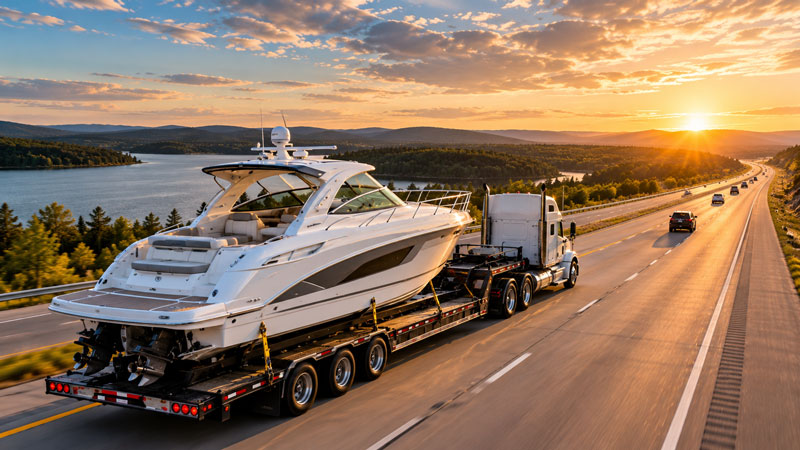
Table of Contents
Shipping a boat overland isn’t complicated, but the pricing isn’t always obvious either. The number depends on how long and wide your boat is, how far it’s going, what kind of trailer it needs, and when you’re moving it.
This guide breaks down what boat transport actually costs in 2026 — by size, by distance, and by the factors that push the price up or down. We also cover how the process works, what to do before pickup, and what to look for in a broker.
We’re US Car-Go Freight, a licensed auto transport broker in Tampa, Florida (DOT 3911910, MC 1444325). We arrange overland boat and yacht transport across the 48 contiguous states.
Get a free boat transport quote or call (888) 249-8840, Monday to Saturday.
The Short Answer
Boat Transport Cost: Quick Answer
For most overland boat shipments in the US, budget $1.25 to $4.00 per mile for a standard trailerable boat. A 500-mile haul on a mid-size boat runs roughly $900 to $2,500. Cross-country moves of 2,500 miles or more for larger yachts can reach $5,000 to $15,000.
These are planning ranges, not quotes. Your price depends on your boat’s length, beam width, trailer type, route, and the time of year.
Cost by Boat Size
Boat length is the single biggest driver of price. Longer boats need longer trailers, which are harder to route and require more carrier effort on tight roads.
| Boat Length | Typical Cost Range | Notes |
|---|---|---|
| Under 20 ft | $300 – $1,500 | Most trailerable boats in this range move on a standard flatbed or customer-supplied trailer |
| 20 to 30 ft | $1,000 – $3,500 | Price varies significantly with beam width and distance |
| 30 to 40 ft | $2,500 – $7,000 | Often requires specialized cradle or hydraulic trailer; wide-load permits may apply |
| Over 40 ft (yachts) | $5,000 – $15,000+ | Typically needs escort vehicles, pilot cars, and oversized routing; price reflects the logistics |
These ranges come from published data by CitizenShipper and actual listings on uShip. A Searay 330 moving from Connecticut to Florida ran $5,800. A 37-ft sailboat from Ohio to California was quoted at $4,400. A mid-size powerboat moving 500 to 800 miles typically falls in the $1,200 to $2,500 range.
Cost by Distance
Per-mile rates are higher on short hauls because fixed costs — pickup scheduling, paperwork, loading time — don’t change regardless of distance.
| Distance | Estimated Cost Range | Approx. Per-Mile Rate |
|---|---|---|
| Under 300 miles | $400 – $1,800 | $2.50 – $4.00/mile |
| 300 to 800 miles | $900 – $3,500 | $1.75 – $3.00/mile |
| 800 to 1,500 miles | $1,800 – $6,000 | $1.50 – $2.50/mile |
| 1,500 miles or more | $3,000 – $15,000+ | $1.25 – $2.25/mile |
According to CitizenShipper’s market data, the typical per-mile rate runs $1.25 to $4.00 for most boats, with a median around $1.85 per mile. Yachts and oversized vessels can reach $25 per mile or more on complex routes.
Florida to California — one of the longer common routes at around 2,700 miles — typically runs $3,000 to $7,000 for a mid-size boat.
How Overland Boat Transport Works
“Boat transport” almost always means overland — a truck and trailer, not a ship. Here’s what the process looks like from start to finish.
Step 1: Quote and booking. You contact a licensed broker, provide your boat’s length, beam, height, weight, pickup location, and destination. The broker matches you with a carrier who has the right equipment and route coverage.
Step 2: Carrier assignment. The broker assigns a licensed, FMCSA-registered carrier. You receive the carrier’s name, contact details, and their insurance certificate before pickup.
Step 3: Pickup. The driver contacts you 12 to 24 hours before arrival. The boat is loaded onto the trailer — a standard flatbed, a cradle, or a specialized hydraulic trailer depending on the vessel. You and the driver complete a condition inspection and sign the bill of lading.
Step 4: Transit. The carrier moves the boat overland. Most moves take 1 to 7 days depending on distance. Oversized loads may require routing around low bridges and state permit windows.
Step 5: Delivery. The driver contacts you before arrival. You inspect the boat, compare it against the bill of lading, and sign the delivery receipt only after you’re satisfied with the condition.
The broker handles carrier vetting, insurance verification, and coordination. The carrier handles the physical move. You are the customer of the broker, not the carrier.
Five Things That Move Your Price
1. Beam width. Width matters more than length for pricing on many routes. A boat with a beam over 8 feet 6 inches typically requires a wide-load permit. Over 12 feet, you may need pilot cars or escort vehicles, which add cost. CitizenShipper’s data shows beam-based pricing ranging from $1.50/mile for narrow boats up to $3.75/mile for beams over 12 feet.
2. Mast height. Sailboats with masts in place can exceed 13 feet 6 inches of height — the standard legal limit on most US roads. If the mast cannot be removed, the carrier needs a special permit and an alternate route. This adds cost and time. Most carriers ask for mast removal before transport.
3. Trailer type. Standard trailerable boats (under about 28 feet, under 8.5 feet wide) can often move on their own trailer, which reduces cost. Larger boats need cradle transport or hydraulic multi-axle trailers, which are specialized equipment with higher day rates.
4. Time of year. Demand for boat transport peaks in spring (April through June) as owners move boats back to summer homes and marinas. Fall and winter — particularly October through February — tend to have more carrier availability and lower prices. Snowbird-season routes from the Midwest and Northeast to Florida peak in October and November.
5. Route and permits. Some routes require state-level wide-load permits, which cost $50 to $300 per state and take 2 to 5 business days to process. Complex routes with multiple permits can add $500 or more to the total. Rural pickup or delivery locations may also add a surcharge of $100 to $200 if the carrier has to leave a main corridor.
How Long Does Boat Transport Take?
Transit time depends on distance and whether your load requires permits.
| Distance | Typical Transit Time |
|---|---|
| Under 500 miles | 1 to 3 days |
| 500 to 1,000 miles | 2 to 4 days |
| 1,000 to 2,000 miles | 4 to 7 days |
| Over 2,000 miles | 7 to 14 days |
Add 1 to 3 days for pickup scheduling on top of transit time. If wide-load permits are required, add another 2 to 5 business days before the move can start. Don’t plan for the boat to arrive the same day you do at the destination — a buffer of two days removes most of the stress.
How to Prepare Your Boat for Transport
A little prep before pickup protects your boat and avoids delays at pickup.
- Wash the hull and take dated photos from every angle — bow, stern, port, starboard, and the deck. Include close-ups of any existing scratches, chips, or damage. Do this before the driver arrives, not after.
- Measure your beam and height. Tell the broker the beam at the widest point and the height from the trailer to the top of any structure. Accurate measurements prevent permit delays and wrong-trailer assignments.
- Remove or secure the mast. For sailboats, this is often required. If the mast comes down, note it in the inspection report. If it stays up, confirm with the broker that the carrier can handle the height.
- Drain or reduce fuel. Most carriers ask for a tank no more than a quarter full. Less fuel means less weight and lower fire risk. Disconnect the battery.
- Remove loose gear. Life jackets, electronics, fishing rods, and anything not bolted down should come off the boat. Carrier cargo insurance generally covers the vessel, not personal items inside it.
- Remove canvas, bimini tops, and antennas if they can catch wind or are not secured. Anything that can act as a sail at highway speed should be taken off or tied flat.
- Inspect with the driver at pickup. Walk around the boat together, agree on the condition, and sign the bill of lading only after you’ve confirmed it accurately reflects what you both see. Keep a copy. Our guide to the bill of lading explains what to look for.
Why Book Through a Licensed Broker
A broker’s job is to find you a licensed, insured carrier and coordinate the move. Here’s what that actually means in practice:
Carrier vetting. A broker checks FMCSA registration, insurance certificates, and safety ratings before assigning a carrier. You don’t have to do this yourself.
Insurance. Every carrier must hold cargo insurance. Ask for the certificate before pickup. Carrier coverage typically runs $100,000 to $250,000 for cargo. Check whether your boat’s agreed value falls within that, and confirm with your own insurance provider whether your marine policy covers overland transit.
Written quotes. A reputable broker gives you the total in writing — what it covers, what could change it, and what’s excluded. Don’t accept a verbal quote.
Credentials to verify. We’re US Car-Go Freight, licensed under DOT 3911910 and MC 1444325. You can look up both numbers on the FMCSA SAFER system. Ask any broker you contact to do the same.
One contact from booking to delivery. You deal with a single coordinator who knows your shipment, rather than a call center that starts fresh every time you call.
Boat Transport FAQ
For a typical mid-size boat (20 to 30 ft), a 500-mile haul usually runs $900 to $2,500 on a standard trailer. Wider boats or those needing cradle transport will be at the higher end. Per-mile rates on shorter hauls tend to run $1.75 to $3.00.
Using your own trailer (if the boat is trailerable) is the cheapest option, but it’s only practical for shorter distances and adds mileage to your tow vehicle. For longer hauls, open overland transport on a shared trailer is the most cost-effective broker option. Rates are lower when you book early and your pickup window is flexible.
For most overland moves, yes — if the mast height puts the total load over 13 feet 6 inches, which is the standard US road height limit. Some carriers can arrange special permits for taller loads, but this adds cost and lead time. Confirm with your broker before booking.
A cross-country move of 2,500 miles or more typically takes 7 to 14 days in transit, plus 1 to 3 days for pickup scheduling and 2 to 5 days if wide-load permits are needed. Plan for two weeks from booking to delivery on longer routes.
Every FMCSA-registered carrier is required to carry cargo insurance, typically $100,000 to $250,000. Ask for the certificate before the driver picks up. Check whether your own marine insurance policy extends to overland transport — some do, some don’t. If there’s a gap, ask your broker about supplemental coverage options.
Some carriers allow it with prior approval, but carrier insurance generally does not cover personal items inside the vessel. Remove electronics, fishing gear, and anything valuable. If you do leave items on board, get written confirmation from the carrier and keep a separate inventory.
Ready to Ship Your Boat?
Tell us your boat’s length, beam, pickup location, destination, and the dates that work for you. We’ll match you with a licensed carrier and send a written quote.
Request your free boat transport quote → or call (888) 249-8840, Monday to Saturday.
Last updated: October 2026. Prices are planning estimates based on market data and change with route, vessel size, and season.
Related Reading
Recent Posts.
- How Much Does Boat Transport Cost? 2026 Price Guide
 How Much Does Boat Transport Cost? 2026 Price Guide Table… Read more: How Much Does Boat Transport Cost? 2026 Price Guide
- Ship Car Texas to Florida: Cost & Timeline (2026)Ship Car Texas to Florida: Cost & Timeline (2026) Table… Read more: Ship Car Texas to Florida: Cost & Timeline (2026)
- Broker vs Carrier vs Marketplace Auto Transport: Complete GuideBroker vs Carrier vs Marketplace Auto Transport: Complete Guide ❓… Read more: Broker vs Carrier vs Marketplace Auto Transport: Complete Guide