
Auto Transport Scams: Red Flags to Spot Before You Book
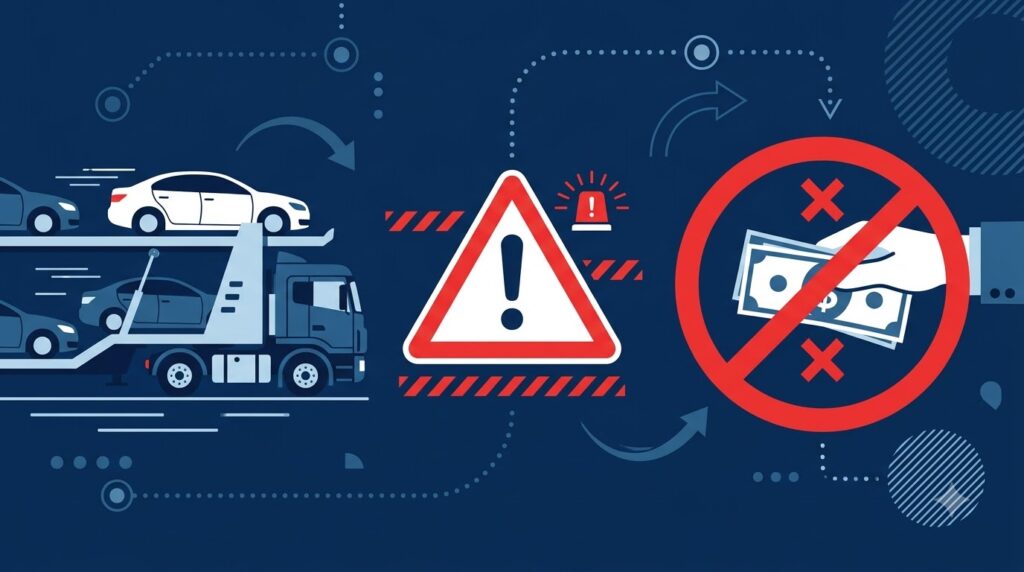
You found a car shipping company online. The quote looks reasonable. The website looks professional. You’re ready to book.
Then they ask for a deposit. A large one. Before a carrier is even assigned.
This is where a lot of customers lose money — and never see that deposit again. The car shipping deposit scam is one of the most reported fraud types in the auto transport industry, and it’s effective precisely because it happens before you have any leverage.
Auto transport scams are actually more prevalent than you think and follow a certain pattern. Knowing what signs to look out for makes these schemes easy to identify. Here we explain, step by step, what these car transport scams are, what the red flags look like, and how you can check the legitimacy of any broker within 60 seconds using a free government database.
How Do Auto Transport Scams Work?
Most car shipping scams follow one of three patterns: the deposit scam, the bait-and-switch, or the hostage vehicle. Understanding how each one works is the fastest way to protect yourself.
The deposit scam is the most common. An unlicensed broker — or sometimes a fake company using a real company’s name — collects a large upfront payment before assigning a carrier to your shipment. Once they have your money, communication goes quiet. Calls go unanswered. Emails bounce. By the time you realize something is wrong, the money is gone.
Bait-and-switch begins with offering a quote that is significantly lower than what others are offering. After booking and paying a deposit, the company offers another price due to “unexpected route changes,” discrepancies in weight, or fuel surcharges that were not in the original quote. The low price was never real. It was designed to get you committed before the real cost appeared.
The hostage vehicle is less common but more stressful. A carrier picks up your car as agreed, then refuses to deliver it until you pay an inflated amount above the agreed price. The leverage is obvious — your car is already on a truck somewhere.
All three scams rely on the same thing: getting your money or your vehicle before you can walk away.
What Are the Red Flags of a Car Shipping Scam?

They ask for a large deposit before a carrier is assigned
A legitimate broker does not need your money before they have confirmed a carrier for your shipment. The industry standard is a small booking deposit — or no deposit at all — with the balance paid at or after delivery.
If a company asks for a large deposit the moment you agree to book, before any carrier is scheduled and before you have a pickup date confirmed, that is the clearest warning sign in the industry.
At US Car-Go Freight, we do not charge a deposit until your carrier is assigned and you’ve confirmed the details. You’re not financially committed until you know who is coming and when.
They request payment by wire transfer, cash, or Zelle
Legitimate car shipping companies accept traceable payment — credit card or check. Scammers push for wire transfers, cash, prepaid debit cards, or peer-to-peer payment apps like Zelle, Venmo, or Cash App. These are nearly impossible to reverse once sent.
If a company won’t accept a credit card, treat that as a serious red flag.
They can’t give you a DOT number or MC number
Every licensed auto transport broker in the United States is required to register with the Federal Motor Carrier Safety Administration (FMCSA). This registration gives them a DOT number and an MC (Motor Carrier) number. These are public records.
A legitimate company will give you both numbers immediately when asked. A scammer won’t have them — or will give you a fake number that doesn’t match anything in the FMCSA database.
Their reviews look artificial
Scammers will create fake reviews. This can be easily spotted if you know what to look for. It consists of multiple reviews appearing within a short period of time, generic wording with no specific details (no route, no vehicle type, no dates), and reviewer profiles with no history outside of that one review.
Genuine reviews mention specifics. A real customer who shipped a car from Chicago to Phoenix will say so.
They pressure you to book immediately
“This price is only good for today.” “We have one carrier spot left on that route.” “If you don’t confirm now, I can’t hold this rate.”
This is not how a legitimate broker would behave. Legitimate companies would always give you enough time to compare quotes, ask questions, and make sure that the broker is legitimate. The pressure to book quickly serves to prevent you from doing all this.
Their contact information doesn’t check out
A physical address that doesn’t exist. A phone number that goes straight to voicemail. A website built entirely on stock images with no real team photos or verifiable history. No physical presence, no street address, no way to find them after they have your money.
Search the company name alongside the word “complaints” before booking. Check the Better Business Bureau. Search their address on Google Maps.
How to Verify a Car Shipping Broker in Under 60 Seconds
The FMCSA keeps a public database of every registered broker and carrier in the United States. Checking any company takes less than a minute.
Go to safer.fmcsa.dot.gov and enter the company’s DOT number or MC number. You’ll see:
- Whether their operating authority is active (if it says “revoked” or “inactive,” stop)
- Whether they’re registered as a broker or a carrier
- Their registered business address
- Any safety violations or out-of-service orders on record
You can also search by company name if you don’t have their numbers yet.
US Car-Go Freight is registered under DOT #3911910 and MC #1444325. Look us up — everything is there.
This check is free, takes under a minute, and is the single most reliable way to separate legitimate companies from fraudulent ones.
What Does a Legitimate Auto Transport Process Look Like?
Knowing what the real process looks like makes the fake version easier to spot.
Step 1: Quote. A legitimate broker gives you a quote based on your route, vehicle type, and transport type (open or enclosed). The quote should be itemized. No vague “starting from” prices.
Step 2: Carrier assignment. The broker posts your shipment to a carrier network and matches you with a licensed, insured carrier for your route. This usually takes 1–5 business days depending on your route and timing.
Step 3: Deposit (if any) after assignment. A deposit — if one is charged at all — comes after a carrier is confirmed, not before. You should know who is picking up your vehicle, when, and what they’re driving before any money changes hands.
Step 4: Pickup and Bill of Lading. At pickup, the carrier documents your vehicle’s condition in writing. Both you and the driver sign the Bill of Lading. Keep your copy. This is your legal record if anything is disputed at delivery.
Step 5: Delivery and final payment. The balance is paid at or after delivery, once your vehicle is in your hands and you’ve had a chance to inspect it against the pickup condition report.
If a company’s process skips Step 3 and asks for full payment at Step 1, walk away.
What Should I Do If I've Already Been Scammed?
If you’ve paid a deposit and a company has stopped communicating, act quickly.
Dispute the charge immediately. If you paid by credit card, call your card issuer and initiate a chargeback. Do this as soon as possible — most issuers have a 60–120 day window.
File a complaint with the FMCSA. Go to nccdb.fmcsa.dot.gov to submit a complaint against a broker or carrier. The FMCSA tracks these complaints and uses them in enforcement decisions.
Report to the FTC. File a complaint at reportfraud.ftc.gov. The Federal Trade Commission tracks fraud patterns and uses complaint data to pursue enforcement action.
File with your state attorney general. Most state AG offices have a consumer protection division that handles fraud complaints.
Wire transfers and cash payments are very difficult to recover. Payment apps like Zelle have limited dispute processes. This is why using a credit card for the initial deposit — even if you’d prefer to pay another way — gives you meaningful protection that cash never will.
Why US Car-Go Freight Does Things Differently
We’re a licensed auto transport broker based in Tampa, Florida. Our operating information is public and verifiable: DOT #3911910, MC #1444325.
We verify active cargo insurance on every carrier before assigning them to any shipment. We do not charge deposits before a carrier is confirmed. We assign one direct point of contact to every customer from quote to delivery — not a call center, not a ticket queue.
We’re not the only legitimate broker in this industry. But if you’re comparing us to a company that asked for a large deposit before telling you who’s picking up your car, that difference is worth paying attention to.
If you want a quote with no commitment required until a carrier is assigned, start here.
Frequently Asked Questions About Auto Transport Scams
What is a car shipping deposit scam and how does it work?
A car shipping deposit scam happens when a fraudulent broker collects a large deposit before assigning any carrier. Once they have your money, they stop communicating. The deposit is gone, no carrier is ever scheduled, and the company becomes unreachable. Legitimate brokers do not collect large deposits before confirming a carrier for your shipment.
How can I check if a car shipping company is legitimate?
Go to safer.fmcsa.dot.gov and search the company’s DOT or MC number. Every licensed broker and carrier in the US is required to be registered there. If their authority shows as inactive or revoked, or if they can’t give you a number to look up, do not book with them.
What payment methods should I avoid when booking car shipping?
Avoid wire transfers, cash, prepaid debit cards, and payment apps like Zelle, Venmo, or Cash App. These are difficult or impossible to reverse if something goes wrong. Pay with a credit card when possible — it gives you the ability to dispute the charge if the company fails to deliver.
What is a bait-and-switch in auto transport?
A bait-and-switch starts with a quote that’s lower than market rate to get you to commit. After you book and pay a deposit, the company raises the price — citing fuel surcharges, route changes, or weight differences. The low initial quote was never intended to be the final price.
What should I do if a car shipping company has my vehicle and is demanding extra payment?
Never make payments without documentation. Ask for a written description of any additional charges. In case the additional charge does not have a legitimate basis under the contract terms, inform the FMCSA at 1-888-368-7238 right away. Preserve all written documentation of your communication and the original copy of the contract.
Is it safe to ship a car with a broker?
Yes, if the broker is FMCSA-registered and verifies the carrier’s insurance before assignment. The licensed broker is your middleman in dealing with carriers, which helps to expand the route options and enjoy more competitive pricing than working directly with the carrier. The key is verifying registration before you pay anything.
Get a Free Auto Transport Quote — No Deposit Until a Carrier Is Assigned
Ready to work with a broker you can verify? Get a free quote in under two minutes — no deposit, no commitment until your carrier is confirmed. If you have questions before booking, call us at (888) 249-8840. We handle every shipment with one direct point of contact from start to finish. Get your free car shipping quote today.
Recent Posts.
- Auto Transport Scams: Red Flags to Spot Before You Book
 Auto Transport Scams: Red Flags to Spot Before You Book… Read more: Auto Transport Scams: Red Flags to Spot Before You Book
- How Much Does Boat Transport Cost? 2026 Price Guide
 How Much Does Boat Transport Cost? 2026 Price Guide Table… Read more: How Much Does Boat Transport Cost? 2026 Price Guide
- Ship Car Texas to Florida: Cost & Timeline (2026)
 Ship Car Texas to Florida: Cost & Timeline (2026) Table… Read more: Ship Car Texas to Florida: Cost & Timeline (2026)


